
The short answer
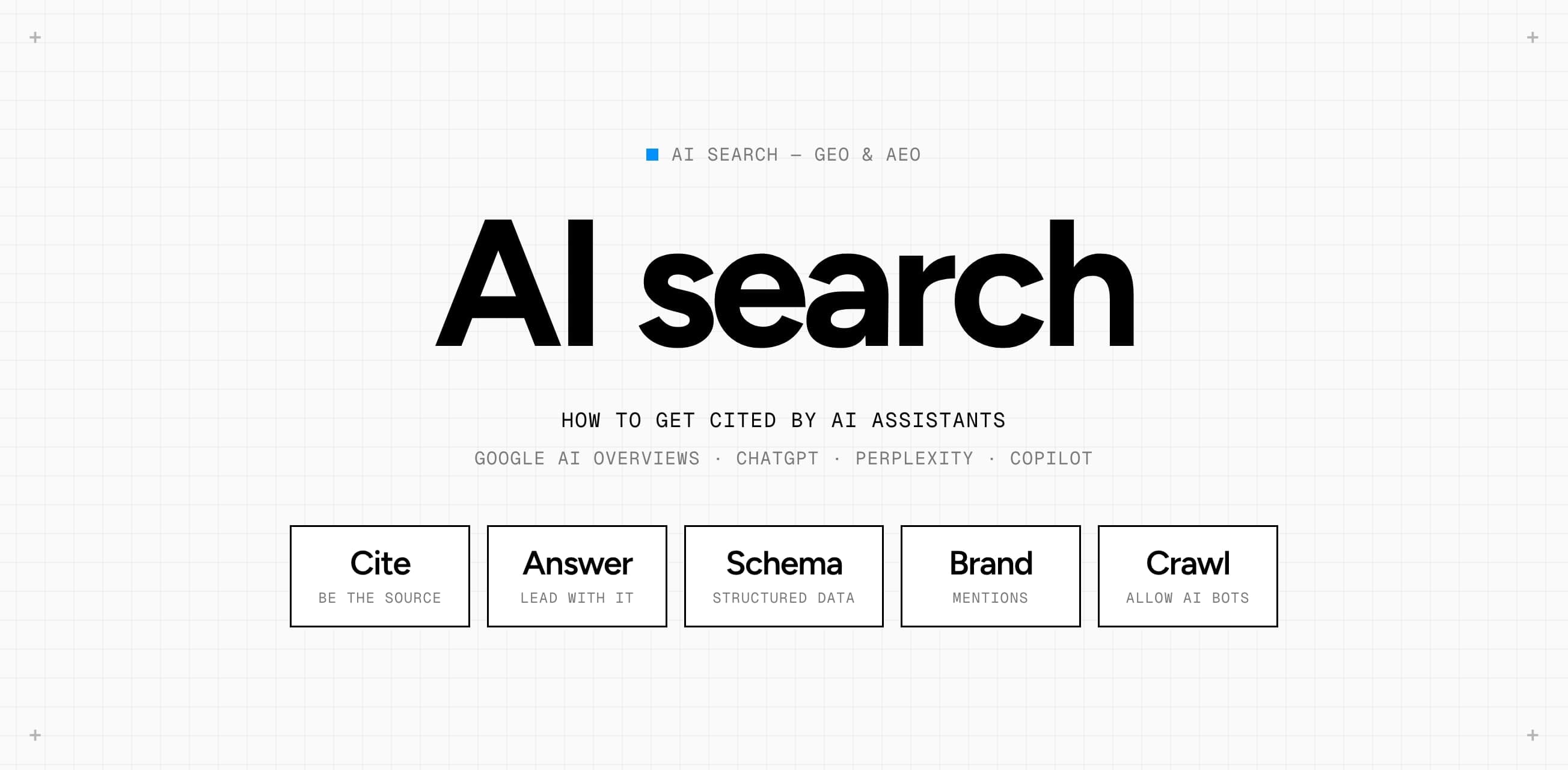
AI assistants cite pages that are crawlable, answer a question directly, are clearly structured and are confirmed by other sources. That isn’t a separate discipline next to SEO, it’s SEO with a higher bar. If your site is technically sound, each page answers one question clearly and you’re mentioned beyond your own site, you end up in answers. If not, you quietly disappear from a channel that grows every month.
What GEO and AEO mean
The terms get thrown around, so let’s be precise. AEO is optimising for answer engines: making sure a system picks your page to answer a specific question. That started with featured snippets and voice search. GEO is the broader version for generative systems like ChatGPT, Perplexity, Copilot and Google AI Overviews, which write an answer from several sources and name those sources.
In practice both ask the same of your site. That’s why we treat them as one within SEO and AEO: the technical foundation, content that answers, and the signals beyond your site that say you can be trusted.
How AI assistants pick their sources
Every assistant works slightly differently, but the pattern is the same. First the question is turned into one or more search queries. For those they use a search index: Google for AI Overviews and Gemini, Bing for ChatGPT and Copilot, its own index for Perplexity. From those results they fetch a handful of pages, read them, and write an answer with references to the passages they used.
That’s three gates. You have to be in the search index, so regular SEO remains the foundation. Your page has to be readable by the assistant’s crawler. And your text has to contain a passage that carries the answer on its own, without the reader needing the rest of the page.
Step 1: let AI crawlers in
Check your robots.txt. Since 2023 many sites block all AI bots in one go, often through a hosting default or a plugin. That also blocks the crawlers that fetch search results: GPTBot and OAI-SearchBot for ChatGPT, PerplexityBot, ClaudeBot and Google-Extended. Choose deliberately. If you want to be cited, the search crawlers have to get in; the training crawlers you can block separately.
Also check that your content is in the HTML without JavaScript. Most AI crawlers don’t execute JavaScript. A site that only shows content after loading is empty to them. It’s the same check as in a technical SEO audit, and it weighs more here.
Step 2: lead with the answer
AI assistants cite passages, not pages. A passage works when it stands on its own: a heading that asks the question, the answer right below it in two to four sentences, and only then the nuance. This article does exactly that. The ‘short answer’ at the top is the passage an assistant lifts.
- One question per page or section. A page that half-covers five topics gets cited for none of them.
- Headings as questions. ‘What does a technical SEO audit cost?’ works better than ‘Pricing’. Assistants match headings to the user’s question.
- Concrete and verifiable. Numbers, steps, definitions and comparisons get picked up more often than opinions.
- Name yourself. ‘At Visinex an audit is ready within a week’ ties the answer to your brand. An anonymous answer gets summarised without you.
Step 3: make the structure machine-readable
Structured data tells a machine what a page is without it having to guess. For AI visibility four types matter most: Organization with your name, address and profiles, Service or Product for what you offer, Article with author and date for articles, and FAQPage for question-and-answer blocks. Put them on every page as JSON-LD and validate them; one error and the block is ignored.
Beyond that: a clear heading structure, tables for comparisons, lists for steps. Not because it looks nice, but because a model can lift a table verbatim. How we approach it is on structured data.
Step 4: get mentioned beyond your own site
An assistant trusts a source more when other sources say the same. That means mentions on review platforms, in industry lists, in interviews and guest articles, and on the sites of clients and partners. It doesn’t have to be a link; a consistent name, the same description and the same address everywhere already count. This is the part that takes the most time and that you can’t skip.
Step 5: measure what AI says about you
You can’t steer what you don’t measure. Every month, ask ChatGPT, Perplexity and Google the same ten questions the way a customer would, and note who gets mentioned and with which source. If you see competitors and not yourself, look at which of their passages gets lifted and why. We do this in an AI visibility report, but a spreadsheet gets you a long way.
| Assistant | Search index | What matters most |
|---|---|---|
| Google AI Overviews | Your regular rankings, structured data, E-E-A-T | |
| ChatGPT (with search) | Bing | Bing indexing, direct answers, brand mentions |
| Perplexity | Own index | Current, factual passages with a clear source |
| Microsoft Copilot | Bing | Bing indexing and structured data |
What this means for your SEO
None of the above replaces SEO. All of it builds on it. The sites that appear in AI answers are the same sites that are technically sound, write clearly and have a reputation. The difference is that AI raises the bar and punishes harder: a page in position four still gets clicks in Google, in an AI answer it doesn’t exist. If you want to know where you stand, the free AI Growth Scan shows in a few minutes what AI assistants currently say about your site.
What’s the difference between SEO, AEO and GEO?
Should I allow AI crawlers in robots.txt?
Does an llms.txt file help?
How long before you appear in AI answers?

Chris Nijhof is the founder and creative director of Visinex. He designs brands, websites and product interfaces for founders and growing companies.