
The short answer
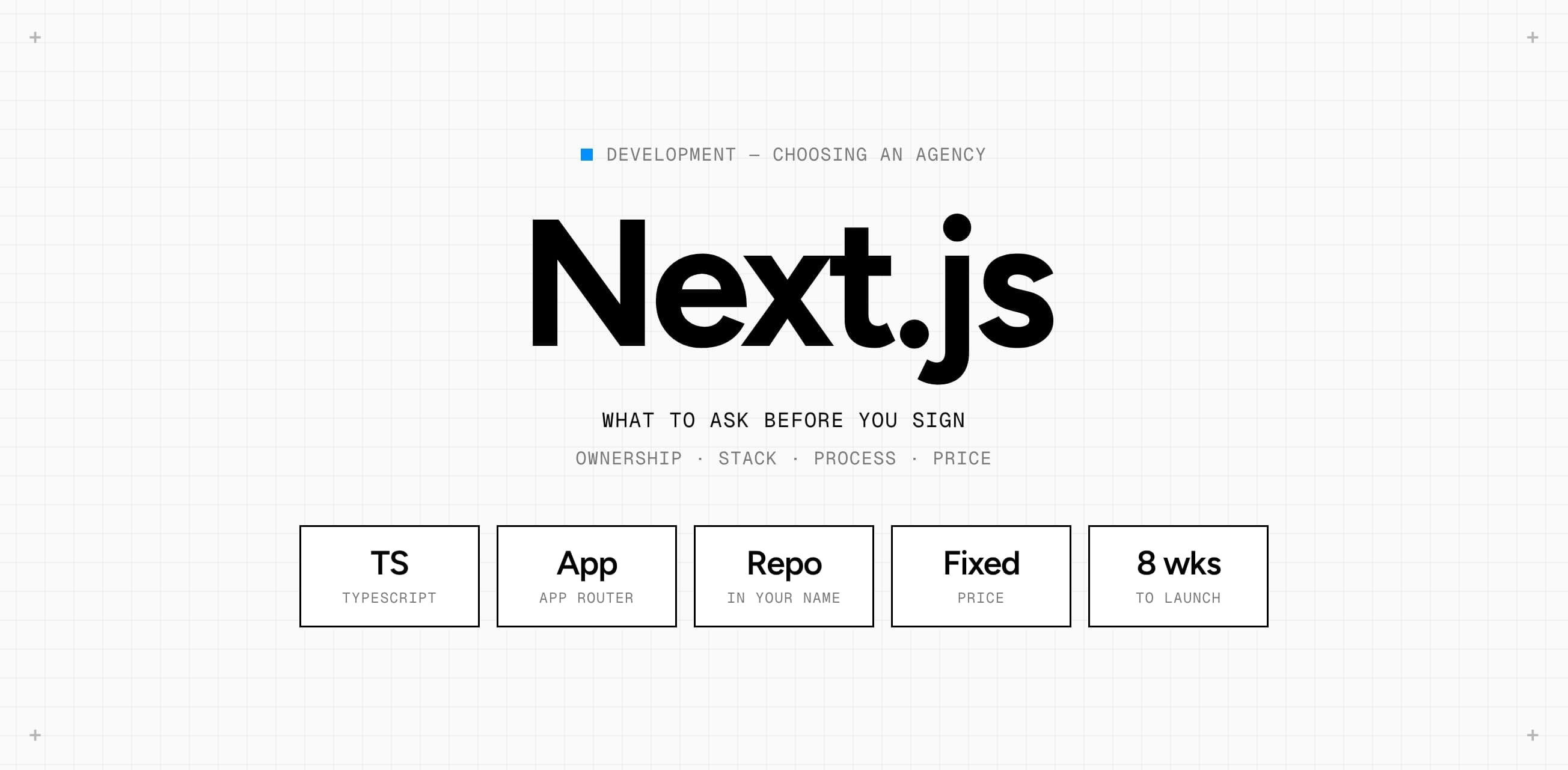
A good Next.js agency gives you code in your own repository, TypeScript, the App Router, a fixed price and a schedule measured in weeks. It can show you which sites it has built and who still works on them. If you hesitate on more than two of the ten questions below, pick another agency.
When Next.js is the right choice at all
First the honest question: do you need Next.js? For a ten-page marketing site with a blog, usually not. Framer or Astro is faster, cheaper and easier to manage yourself. Next.js becomes the right choice once your site is really a product: a customer portal, a configurator, a dashboard, a site with hundreds of pages from a database, or integrations with your CRM, payments and internal systems.
An agency that doesn’t ask that question and recommends Next.js straight away is selling a stack instead of a solution. We build in Framer, Astro and Next.js ourselves and recommend per project which one fits. Every agency should be able to do that.
Ownership: three questions
1. Who owns the code, and where does it live?
The right answer: in a repository in your name, from day one, with the agency as a collaborator you can remove. Not ‘after the final payment’, not ‘in our organisation with you as a guest’. The same goes for hosting, the domain and the accounts of every service the site uses.
2. Can another team take it over?
Ask how a new developer gets the site running. A good agency has a README, an .env.example and a working local setup in under an hour. Also ask about proprietary frameworks or ‘internal tooling’ on top of Next.js. The more of that, the more locked in you are.
3. Which services sit underneath and what do they cost per month?
A Next.js site rarely runs alone. Hosting (usually Vercel), a database, a CMS, email, analytics. Have the agency write out the monthly cost per service up front and whose name each subscription is in. A ten-thousand-dollar site with three hundred dollars a month in services you didn’t know about is a bad surprise.
Stack: three questions
4. Do you build with TypeScript and the App Router?
This is the fastest test. TypeScript catches errors before they go live and makes the code transferable. The App Router has been the standard way to build in Next.js since 2023, with server components and streaming. An agency still building on the Pages Router ‘because that’s what they know’ delivers a site that stalls at the first major upgrade.
5. How will I manage the content myself?
Next.js has no built-in CMS. A good agency picks one that suits you, such as Sanity, Payload or a custom admin, and lets you edit a page before handover. Ask what happens with SEO fields, images and multiple languages. If the answer is ‘we’ll do that for you’, you’ll depend on them for every comma.
6. How do you guarantee SEO and speed?
Next.js can be blazing fast and also very slow, depending on how it’s built. Ask for Core Web Vitals of previously delivered sites, for server-side rendering of your key pages, for metadata, sitemaps and structured data. An agency that includes a technical SEO audit in its handover has thought about this.
Process: two questions
7. Who does the work, and will I see those people?
The difference between a senior team and a salesperson with an offshore team behind them only shows after kickoff. Ask who the designer and the developer are, whether you’ll talk to them during the project and whether they wrote the quote. At Visinex the same small team designs and builds, on purpose: the person who draws the flow also builds it.
8. What does the schedule look like and what will I see when?
A good answer counts in weeks and has fixed moments: architecture and design in the first weeks, a working preview URL from the first build, and a launch with a checklist. Most of our Next.js builds go live in about eight weeks. An agency that only says ‘end of the quarter’ has no schedule.
Price: two questions
9. Fixed price or hourly?
Hourly is fine for maintenance and small changes. For a build it’s a risk that sits entirely with you. An agency that knows the scope can give a fixed price. Custom development starts at $7,000 with us, depending on the number of screens and integrations, and that price is fixed before kickoff. The principles are on our pricing page.
10. What happens after launch?
Next.js, React and the services underneath get updates. Ask who handles those, what that costs and how quickly security updates are applied. A maintenance agreement shouldn’t be an obligation, but it should be an option with a clear price.
The signals that make you walk away
- No live examples where you can view the source in the browser
- ‘The code is handed over after the final invoice’
- A proprietary framework or page builder on top of Next.js
- A quote without scope, without a schedule, or hourly only
- No answer to the question of who the developer is
| Question | Good answer |
|---|---|
| Who owns the code? | You do, in your repository, from day one |
| Which stack? | TypeScript, App Router, a CMS you can operate |
| Who builds it? | The team you talk to and that wrote the quote |
| How long does it take? | A schedule in weeks with a preview URL from the first build |
| What does it cost? | A fixed price before kickoff, plus the monthly cost of services |
How much does a Next.js website cost?
How long does it take to build a Next.js website?
Is Next.js good for SEO?
Do I have to host Next.js on Vercel?

Chris Nijhof is the founder and creative director of Visinex. He designs brands, websites and product interfaces for founders and growing companies.